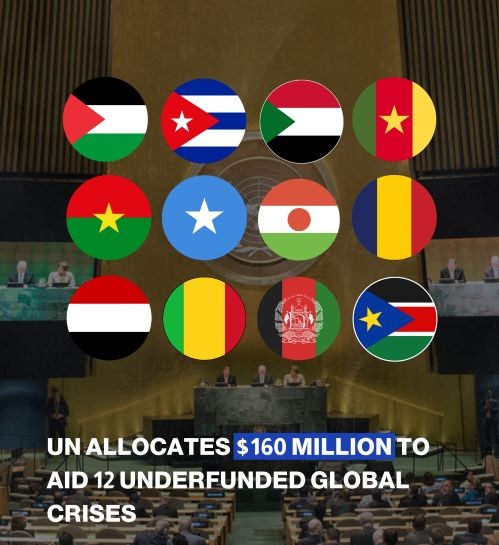
Somalia, South Sudan and Sudan will receive a combined $47 million as the UN directs scarce humanitarian resources towards some of the world’s most underfunded crises, with implications for migration, food security and economic stability across the wider East African region.
By Business Insider Reporter
East Africa and its immediate neighbours are set to receive a significant share of a new US$160 million United Nations emergency funding package, as prolonged conflicts, climate shocks and displacement continue to put pressure on humanitarian systems and regional economies.
The UN Office for the Coordination of Humanitarian Affairs (OCHA) announced on October 2 that Somalia will receive US$16 million, South Sudan US$15 million and Sudan US$16 million from the Central Emergency Response Fund (CERF).
Together, the three countries will receive US$47 million, or nearly a third of the US$150 million allocated directly to humanitarian operations across 12 crises.
For Tanzania and the wider East African region, the allocation matters beyond the countries receiving the money directly. Instability, food insecurity and displacement in neighbouring and nearby countries can spill across borders, affecting refugee movements, regional trade and already stretched humanitarian resources.
The funding comes as the UN seeks to reach 87 million people facing the world’s most severe humanitarian needs this year.
“We have 87 million people to reach, and no time to waste. Today’s new funding will help us get aid to people who might otherwise be left behind,” said Tom Fletcher, UN Under-Secretary-General for Humanitarian Affairs and Emergency Relief Coordinator.
He cautioned, however, that funding alone would not resolve the problem, calling for political action to secure humanitarian access and remove obstacles preventing assistance from reaching vulnerable communities.
Africa takes large share
Africa features prominently in the latest allocation. In addition to Somalia, South Sudan and Sudan, funding will go to Burkina Faso (US$10 million), Cameroon (US$6 million), Chad (US$9 million), Mali (US$10 million) and Niger ($US$10 million).
That means eight of the 12 crises receiving funding are in Africa, accounting for US$92 million of the US$150 million earmarked for country-level responses.
The remaining allocations will support Afghanistan and the Occupied Palestinian Territory, each receiving US$18 million; Yemen, US$18 million; and Cuba, US$4 million.
A further US$10 million will specifically address the needs of people with disabilities across the 12 crises. The UN Global Disability Fund will provide up to another US$4 million in complementary financing and technical assistance.
Regional economic implications
For East Africa, humanitarian emergencies increasingly overlap with economic challenges.
Conflict and extreme weather can disrupt agricultural production and cross-border trade, while displacement puts additional pressure on host communities and public services. This makes humanitarian financing relevant not only to emergency relief but also to regional economic resilience.
Tanzania, which has historically hosted refugees from conflicts in the Great Lakes region, has an interest in greater stability across neighbouring economies even though it is not among the recipients of the latest CERF allocation.
The latest package brings total CERF allocations in 2026 to US$483 million.
However, that remains well below the fund’s annual financing target of US$$1 billion, illustrating the widening gap between humanitarian needs and available resources.
Since its establishment by the UN General Assembly in 2005, CERF has provided about US$10.2 billion across more than 117 countries and territories, including US$3.4 billion directed towards underfunded emergencies.
The fund has also expanded its role in responding to climate-related emergencies. Its Climate Action Account, launched at COP28, is designed to provide rapid financing to communities facing climate shocks, including through measures taken before disasters reach their worst stages. For East Africa – a region confronting a combination of climate vulnerability, conflict and displacement – the latest allocation offers immediate relief. But the scale of humanitarian financing needs suggests that emergency funding alone will not substitute for longer-term investment in peace, climate resilience and economic stability.