By Correspondent Benny Mwaipaja
Tanzania is seeking to turn the Central Corridor from a transport route into a broader economic engine, with the World Bank signalling renewed support for infrastructure and investments designed to generate jobs, expand trade and unlock value from production along the corridor.
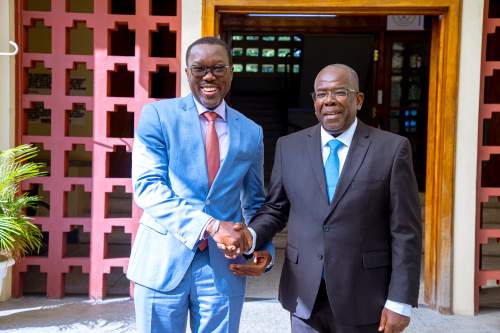
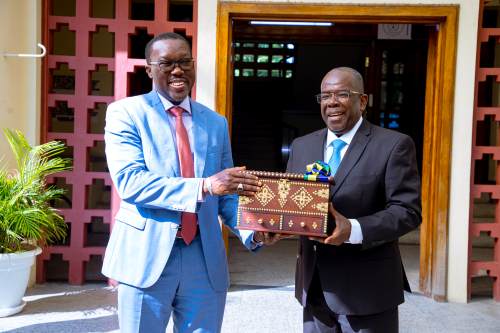
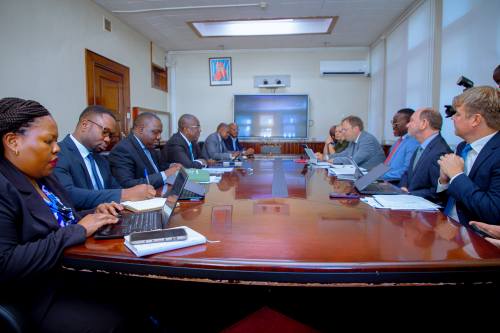
The commitment was made by World Bank Vice President for Eastern and Southern Africa, Dr. Ndiame Diop, during talks with Finance Minister Ambassador Khamis Mussa Omar in Dar es Salaam, on the second day of his visit to Tanzania.
The message from the World Bank is significant: the future of the Central Corridor may depend less on how quickly goods can move through Tanzania and more on how much economic activity can be generated along the route.
For years, the corridor has served primarily as a gateway linking Tanzania’s port and transport infrastructure with landlocked markets, particularly in the Great Lakes region. The emerging ambition is to build an economic corridor around that infrastructure – one that connects farmers, manufacturers, miners, logistics companies and investors to regional and international markets.
From transport route to economic corridor
Dr Diop said the World Bank saw considerable scope for strengthening cooperation with Tanzania to develop the Central Corridor and transform it into an economic corridor capable of creating large numbers of productive jobs.
That transformation would involve investment in critical infrastructure, including ports and railways, as well as extending rail connectivity towards Burundi.
But infrastructure, on its own, will not deliver the full economic dividend.
The World Bank’s proposed approach places equal emphasis on economic activity along the corridor, including agricultural production and processing, mining and mineral processing, logistics hubs and other support services.
This is where the Central Corridor could become particularly important for Tanzania’s industrialisation ambitions.
A functioning corridor can reduce the cost and time of moving goods. An economic corridor can go a step further by encouraging businesses to locate processing, storage, manufacturing and distribution facilities along the route.
That distinction matters.
If Tanzania can process more agricultural commodities, minerals and other raw materials before they leave the country, the corridor could generate greater domestic value, create new businesses and expand employment rather than simply facilitating the movement of largely unprocessed goods.
Dr. Diop said greater private-sector participation would be critical to this transition, particularly if Tanzania and neighbouring countries are to move away from exporting raw materials towards higher-value products.
The infrastructure challenge
The World Bank’s focus on ports, railways and energy also highlights one of the central constraints facing the corridor: infrastructure must expand in tandem with economic activity.
Dar es Salaam’s port is a strategic gateway for Tanzania and several landlocked economies. Rail connectivity, meanwhile, determines how efficiently cargo can move inland and whether the corridor can compete with alternative regional trade routes.
The expansion of rail links towards Burundi could therefore have implications beyond Tanzania’s domestic market, potentially strengthening the country’s position as a regional logistics and trade hub.
But the economic case will ultimately depend on reliability and cost.
For businesses, a corridor is only as useful as its ability to provide predictable transport times, competitive logistics costs, adequate energy and efficient border and customs systems.
This makes the proposed investment agenda broader than roads, ports and railways. It also places pressure on policymakers to continue improving the wider business environment.

Dira 2050 connection
The proposed transformation fits closely with Tanzania’s long-term development ambitions under Tanzania Development Vision 2050 (Dira 2050), which places greater emphasis on productive investment, industrialisation, human capital and private-sector-led growth.
Dr Diop said the World Bank’s cooperation with Tanzania would continue to focus on investments capable of creating large numbers of productive jobs as the country grapples with a rapidly growing population.
The Bank has also secured approval from its Board to continue using its Country Partnership Strategy as the main framework for its engagement with Tanzania, with adjustments to strengthen priority areas.
These include citizen-centred development, particularly education, health and social protection, alongside stronger private-sector development.
The strategy recognises an important reality: infrastructure-led growth cannot be sustained without investment in people.
A new railway may move more cargo, but the wider economic gains will depend on whether Tanzanians have the skills to participate in the businesses that emerge around it.
Similarly, improved logistics infrastructure will create greater value if farmers, manufacturers and small businesses can access finance, technology and markets.
Private sector holds the key
For Finance Minister Ambassador Omar, closer cooperation with the World Bank is central to Tanzania’s economic development priorities.
He said the Government would continue creating an enabling environment for the private sector while strengthening cooperation with the International Finance Corporation (IFC) and the World Bank.
That will require continued domestic reforms to improve the business and investment climate.
This is perhaps the most important test of the Central Corridor strategy.
Public investment can build the backbone of the corridor, but private capital will be needed to populate it with factories, warehouses, processing plants, logistics centres, energy projects and other commercial ventures.
Tanzania’s ability to attract such investment will depend on the predictability of regulations, access to reliable power, availability of serviced land, efficient trade procedures and the overall cost of doing business.
If these conditions improve alongside transport infrastructure, the Central Corridor could become more than a route through which goods pass. It could become a platform for industrialisation.
A sizeable development partnership
The World Bank’s financial commitment already provides a substantial foundation for that ambition.
Through its International Development Association (IDA) window, the Bank’s investment portfolio in Tanzania stands at US$8.96 billion across 35 projects.
Of these, 32 are national projects worth more than US$8.78 billion, while three regional projects account for about US$180 million.
The scale of this financing underlines the importance of Tanzania within the World Bank’s regional development strategy.
But the next phase will require a sharper focus on economic returns.
The challenge is no longer simply to build infrastructure. It is to ensure that infrastructure changes the structure of the economy—raising productivity, supporting industrial activity, expanding exports and creating jobs.
That is the real opportunity presented by the Central Corridor.
If Tanzania succeeds in linking its ports and railways with production, processing, energy, logistics and private investment, the corridor could become one of the country’s most important vehicles for translating infrastructure spending into broad-based economic growth.
The World Bank’s renewed commitment suggests that the financing and development partners may be available. The bigger question is whether Tanzania can build the economic ecosystem needed to turn a transport corridor into a genuine growth corridor.