
By Business Insider Reporter
A new chapter in Tanzania’s financial landscape took shape on Wednesday, April 15, 2026, as KCB Bank Tanzania debuted Mapato Sukuk – a Shariah-compliant investment product aimed at expanding access to ethical finance while deepening the country’s capital markets.
Much like its predecessor, Fursa Sukuk, the new KCB Bank Islamic bond is structured in strict compliance with Shariah principles, which prohibit the payment or receipt of interest (riba).
Rather than earning fixed interest, investors take part in a Mudharabah (profit-sharing) arrangement, where returns are derived from actual business activities financed by the bank, linking profits directly to the performance of underlying assets.
In practical terms, this means investors earn income linked to tangible economic ventures rather than speculative or interest-based gains.
Speaking at the launch event, the bank’s Head of SAHL Banking, Amour Muro, representing Managing Director Cosmas Kimario, framed the product as part of a long-term strategy to widen financial inclusion.
“KCB pioneered Islamic banking in Tanzania in 2008, and we have seen growing appetite for Shariah-compliant solutions,” Mr. Muro told journalist after the launch event. “Our earlier Fursa Sukuk demonstrated strong demand and the potential for Islamic bonds in this market.”
That earlier issuance in 2022 was fully subscribed, signaling strong investor confidence and setting the foundation for Mapato Sukuk. Building on that momentum, the new programme is structured to mobilize up to TSh 30 billion, with an initial tranche of TSh 10 billion now open to investors.
Mr. Kimario, in remarks delivered on his behalf, described the launch as “a strategic and important milestone in how Tanzanians make their investment choices.”
He positioned Mapato Sukuk not merely as a financial instrument, but as “an economic empowerment platform that opens doors for financial prosperity.”
In the presentation of the new bond, Mr Muro said its investment terms are deliberately structured to attract a broad base of participants. The minimum investment is set at TSh 500,000, making it accessible to middle-income investors who may have previously been excluded from capital market opportunities.
The Sukuk has a tenor of three years, maturing in May 2029, and offers expected annual returns of around 11 percent, distributed through quarterly profit payouts. Notably, these returns are exempt from withholding tax, further enhancing the product’s appeal.
“Subscription for the first tranche runs from 15 April to 14 May 2026, with multiple access points designed to simplify participation,” Mr Muro pointed out. “Investors can subscribe through KCB branches, licensed stockbrokers, or digital investment platforms such as the Shirkah App.”
Once issued, the Sukuk will be listed on the Dar es Salaam Stock Exchange (DSE), allowing investors to trade their holdings in a secondary market – an important feature that adds liquidity and flexibility.
Regulators have welcomed the initiative as a significant step toward a more inclusive and diversified financial system. Representing the Capital Markets and Securities Authority (CMSA), Exaut Julius emphasized the broader implications for the national economy.
“Mapato Sukuk is not only a financial inclusion product, but also a catalyst for the development of a sustainable capital market in Tanzania,” Mr. Julius said while delivering a speech on behalf of CEO Nicodemus Mkama. “This instrument promotes and advances ethical finance, which CMSA fully supports and endorses.”
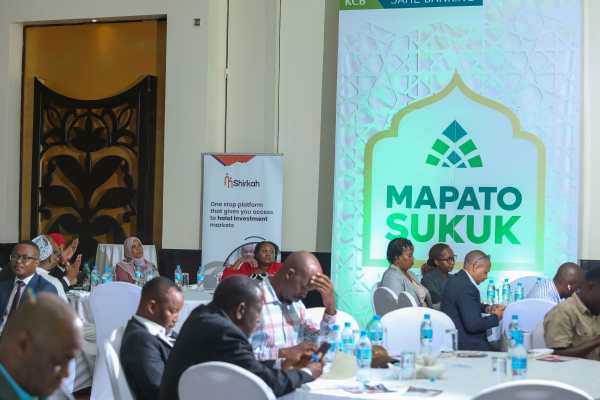
He added that Tanzania’s capital markets have experienced strong growth in recent years, and innovative instruments like Mapato Sukuk will play a key role in sustaining that trajectory. By offering alternatives to conventional interest-based products, such instruments appeal not only to faith-based investors but also to a growing segment seeking socially responsible and transparent investments.
Technology is also central to the Sukuk’s rollout. Salum Awadh, CEO of Shirkah Investment, highlighted how digital platforms are lowering barriers to entry and modernizing how Tanzanians engage with financial markets.
Through mobile-enabled systems, investors can subscribe, track performance, and trade their Sukuk holdings with greater ease. “This is about making investment opportunities simple, transparent, and reachable for ordinary Tanzanians,” Mr. Awadh said, pointing to fintech’s role in democratising access to wealth-building tools.
Beyond its technical features, Mapato Sukuk reflects a broader shift in East Africa’s financial ecosystem toward diversification and ethical finance. It provides a fixed-income alternative without interest, predictable income through quarterly distributions, and the added advantage of tradability on the stock exchange.
For KCB Bank, the launch reinforces its position as a pioneer in Islamic finance in Tanzania. For investors, it offers a rare combination of stability, accessibility, and ethical alignment. And for the market as a whole, it signals growing collaboration between financial institutions, regulators, and technology providers in shaping a more inclusive economic future. As Tanzania continues to expand its financial architecture, Mapato Sukuk stands out as both a practical investment opportunity and a symbol of evolving market sophistication – one that could redefine how wealth is created and shared in the years ahead.