By A Special Correspondent
NMB Bank Plc has invested more than TSh 230 billion in technology between 2021 and 2025, a move that is transforming banking, expanding financial inclusion, and reshaping customer experience across Tanzania.
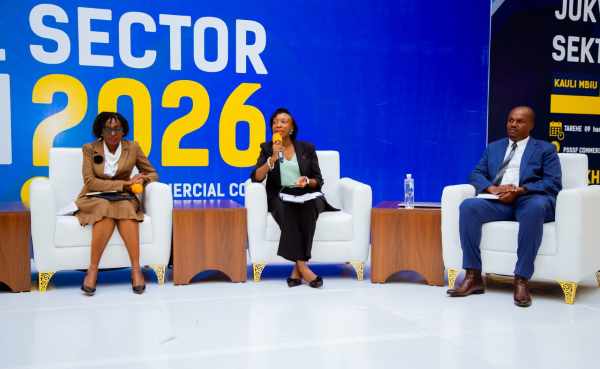
Speaking during a panel discussion on Innovation, Technology and AI in the Financial Sector at the Financial Sector Forum 2026, the Head of Bancassurance, Martine Massawe, said the bank’s sustained digital investment is delivering measurable results across operations, outreach, and product innovation.
The forum, convened by the Ministry of Finance in Dar es Salaam, brought together policymakers and industry leaders to review progress under the Financial Sector Development Master Plan (FSDMP 2020/21–2029/30) and align priorities with DIRA 2050.
Mr. Massawe said annual technology investment has more than doubled from TSh 18.4 billion in 2021 to TSh 43 billion in 2025, with TSh 71 billion directed to core banking systems, strengthening the bank’s digital backbone.
He said the investment has significantly expanded access, with NMB’s customer base growing from 4.6 million to 9.9 million. Its agent network has risen from 8,400 to over 73,000, while branches have increased from 226 to 246.
“These numbers are not just growth – they represent access,” he said, noting that the expansion is also helping deepen insurance penetration.
A key outcome of the digital push has been the digitisation of the lender’s insurance service through platforms such as NMB Mkononi and NMB Jirani, enabling affordable products like FARAJA Funeral Cover, which is attracting around 40,000 new subscribers monthly, with premiums starting as low as TSh 200.
The integration of artificial intelligence into underwriting, particularly through Jirani, is also improving efficiency in products such as Bima ya Kikundi, with faster processing expected across the value chain.
Despite rapid expansion, the bank has maintained a cost-to-income ratio of 37 percent, reflecting strong operational discipline alongside innovation.
“Technology is not about replacing people,” Mr. Massawe said in response to a concern raised by a forum participant about the risk of automation displacing human labour across the banking and wider financial services sector. “Rather, it is about augmenting human capability – strengthening efficiency, expanding opportunity, and enabling employees to deliver greater value through innovation.”
He added that the sector’s progress is supported by regulatory reforms, fintech partnerships, and improving interoperability across the financial system.
Looking ahead, he called for faster regulatory approvals, greater agility, and wider adoption of design thinking to match the speed of technological change.
“Technology is not just about systems – it is about speed,” he said, noting that turnaround time is becoming a key competitive factor as Tanzania advances toward its DIRA 2050 ambitions.
The two-day forum, held on Thursday and Friday, also recognised and commended NMB’s efforts in advancing sustainability financing through its Jasiri and Jamii bonds, highlighting the bank’s growing role in mobilising capital for inclusive and development-oriented growth.
The recognition of NMB Bank Plc’s sustainability financing through its Jasiri and Jamii bonds reflects how the FSDMP is moving from policy to practice.
As outlined in the Jasiri Bond’s impact, these instruments mobilise domestic capital while expanding access to finance, particularly for women-led MSMEs and underserved groups – turning financial inclusion into a measurable outcome. They also deepen Tanzania’s capital markets through innovative, thematic financing aligned with global sustainability and ESG trends.
In this sense, the recognition underscores NMB Bank’s growing role in translating FSDMP goals into real market solutions that combine capital mobilisation, inclusion, and financial innovation.
Speaking during a panel discussion on the banking sector’s role in implementing the Master Plan, Gladness Deogratias, Head of Global Markets at the lender, said the Jasiri Bond effectively translates the FSDMP from policy into practice.
She noted that the bank leveraged the policy space around alternative credit assessment and collateral substitution to design a product tailored to women and youth entrepreneurs – many of whom have viable businesses but limited asset bases.
“In that sense, the Master Plan did not just give us confidence; it gave us legitimacy and a clear framework within which innovation could be pursued and defended, both internally and in the market,” she said. According to her, the bond that raised over TSh 74 billion – nearly three times its initial target – enabled the disbursement of about 6,000 loans, primarily to women-owned and women-led enterprises.