By Business Insider Reporter
As Tanzania advances toward the ambitions of its new long-term development blueprint, Dira 2050, one message is becoming increasingly clear: the country’s transformation will not be driven by vision alone, but by scalable, locally rooted enterprises solving real economic bottlenecks.
Few stories capture this shift more vividly than that of Diana Orembe, co-founder and CEO of NovFeed.
What began as a response to a persistent gap in the aquaculture sector is now a fast-scaling agribusiness on track to generate over US$1 million in annual revenue – offering a compelling case study in the type of private sector innovation Dira 2050 seeks to unlock.
In a recent interview with How We Made It In Africa, Orembe reflects on a journey shaped as much by structural constraints as by entrepreneurial resilience.
“All businesses are difficult,” she says. “If you talk to a woman selling vegetables… or a person running a conglomerate… they will tell you the same.”
Exchange 09
It is a perspective that aligns closely with Dira 2050’s underlying premise: that sustainable growth depends not on avoiding complexity, but on building systems – and businesses – that can navigate and overcome it.
From structural constraint to scalable opportunity
At the heart of NovFeed’s model lies a classic market inefficiency. For years, Tanzania’s aquaculture sector has been constrained by limited access to affordable, high-quality fish feed. Heavy reliance on imports has kept costs high, suppressing productivity and limiting the sector’s potential to contribute meaningfully to food security and economic growth.

For Ms. Orembe, this was not an abstract policy issue – it was a lived reality. Growing up near Lake Victoria, she witnessed firsthand how feed shortages affected small-scale fish farmers. Later, as a microbiology student at the University of Dar es Salaam, she confirmed that the problem persisted across the industry.
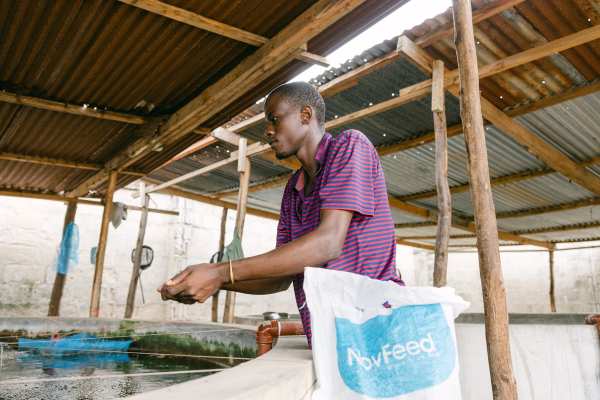
The result was a deliberate pivot toward solution-building. Leveraging scientific research and local resources, she developed a process to convert food waste into fish feed through natural fermentation – creating not only a lower-cost input for farmers but also an organic fertiliser byproduct.
This model speaks directly to Dira 2050’s priorities: industrialisation through value addition, circular economy practices, and reduced import dependence.
The commercialisation challenge
Yet, as Ms. Orembe’s experience underscores, innovation alone is not enough. The real test lies in commercialisation – particularly in markets dominated by smallholder producers.
“I have learned along the journey that the message you’re giving your customers really matters,” she explains. Early attempts to emphasise the science behind the product proved counterproductive. “When you tell a person that this is bacteria-made fish feed, everyone will run away.”
Instead, NovFeed reframed its value proposition around what mattered most to farmers: affordability, reliability, and results. Demonstration farms were used to build trust, while agro-dealer networks helped drive distribution.
This pragmatic approach highlights a critical lesson for Dira 2050: bridging the gap between innovation and adoption requires not just technology, but market understanding, behavioural insight, and sustained engagement with end users.
Scaling growth – and risk
Today, NovFeed stands at a new frontier – one that reflects both the promise and pressure of scaling. Following a US300,000 win at the Africa’s Business Heroes competition, the company has expanded its production capacity to over 20 tonnes of feed per day.
Revenues have followed an upward trajectory, growing from US$420,000 in 2024 and doubling in 2025, with expectations of surpassing US$1 million in 2026.
But increased capacity brings a new set of risks. “I’ve never been able to produce 20 tonnes of feed per day… now where am I going to look for a customer who can access that per day?” Ms. Orembe asks.
Her concern points to a broader structural issue within Tanzania’s growth agenda: the need to synchronise production capacity with market expansion. Without strong distribution systems, access to finance for farmers, and efficient value chains, even the most promising enterprises can face demand-side constraints.
“Being able to produce is just one thing,” she adds. “But at the end of the day, you have to sell. That’s the most, most difficult part.”
A microcosm of Dira 2050
In many ways, NovFeed’s journey mirrors the broader ambitions – and challenges – of Dira 2050. It reflects the shift toward private sector-led growth, where businesses are not just participants in the economy but primary drivers of investment, innovation, and job creation.
It also underscores the importance of building resilient value chains. By localising feed production, NovFeed is strengthening the aquaculture ecosystem, enabling farmers to increase yields, improving incomes, and contributing to national food security.
At the same time, the company’s evolution highlights key enablers that will determine the success of Tanzania’s long-term vision: access to growth capital, market linkages, technical skills, and policy frameworks that support enterprise scaling.
The road ahead
As Tanzania charts its path to 2050, the question is not whether opportunities exist – but whether they can be effectively harnessed. Enterprises like NovFeed offer a glimpse of what is possible when local insight meets innovation and execution.
For Ms. Orembe, however, the journey remains firmly grounded in the realities of business. Growth brings complexity, and success demands constant adaptation.
Her story is not just about building a million-dollar company. It is about demonstrating how solving a single, well-defined problem – when approached with persistence and clarity – can unlock value across an entire sector. In the context of Dira 2050, that may be the most important lesson of all.