

Tanzania’s tea industry is undergoing a major revival, fuelled by government reforms, investor interest, and expanding international demand. The Tea Board of Tanzania (TBT), under the Ministry of Agriculture and the leadership of President Dr. Samia Suluhu Hassan, is spearheading initiatives to transform tea from a traditional cash crop into a value-added, export-led powerhouse.

TBT Director General, Beatrice Banzi
Speaking during the 2025/26 budget wrap-up, Minister for Agriculture, Hussein Bashe, confirmed the government’s renewed commitment to the tea sector – aiming to reduce reliance on green leaf sales by prioritising premium black and orthodox teas.
“We are creating value at home, boosting farmer incomes, and increasing Tanzania’s competitiveness globally,” said Minister Bashe.
Factory revivals, investor partnerships
One of the highlights of the reform agenda is the revival of Kilolo Tea Factory, now in a joint venture with Chinese investors, producing orthodox tea for both local and foreign markets.
Additionally, two modern tea processing machines have been installed at the Kipawa warehouse in Dar es Salaam, with a third en route to Korogwe in Tanga Region.
TBT is also supporting smallholder-owned factories, alongside four new investor-led processing plants in Kilolo and Busekelo districts.
Moreover, the government is reviewing previously privatised but now-dormant tea factories, with the intent of returning them to farmer ownership under current legislation.
Expanding global footprint
TBT has made major gains in international market access through trade exhibitions and diplomatic engagement. Tanzanian tea is now gaining renewed attention in Oman, Qatar, Saudi Arabia, Japan, China, Dubai, and Russia.
– In Oman, the National Tea Company (MUMTAZ TEA) resumed imports after a
21-year break, now sourcing 100 tonnes monthly from Mponde.
– In Saudi Arabia, packaging firm Atayib is testing Tanzanian tea products, laying the groundwork for bulk purchasing.
– In Qatar, local firm AK Confectionery signed export agreements at the AgriteQ Fair, and talks with retail giant Widam are underway to introduce Tanzanian tea to wider consumer shelves.
Asia’s interest grows
Japanese beverage giant, Ito En, plans to source tea from Njombe smallholders for export and processing, while Hong Ding XIN Investment Ltd of China has installed production machinery in Kilolo for global distribution.
In Russia, following a high-level delegation’s visit to Iringa and Njombe, formal export deals are expected soon, according to TBT.
Infrastructure and quality boosts
TBT is upgrading infrastructure to match rising production volumes. The Kipawa warehouse near Dar es Salaam airport now features advanced blending machines, forklifts, and improved ventilation systems.
A similar upgrade is planned for Korogwe. Kipawa has also been designated a logistics hub for Sudanese buyers, easing exports from Tanzania, Malawi, and Burundi.
Additionally, over 4,000 farmers have received Rainforest Alliance Certification, opening access to premium markets while strengthening sustainability and traceability.
Tea auction success
TBT launched a national tea auction system, expanding from one broker to three. The average price per kilo of tea has nearly doubled—from USD 0.58 to US$1.15 – resulting in increased farmer participation and higher industry revenues.
Smallholders at the centre
TBT Director General, Mrs. Beatrice Banzi, stressed the board’s commitment to an inclusive tea ecosystem.
“Our reforms are farmer-focused, ensuring that smallholders benefit from new factories, certification, market access, and infrastructure improvements,” she said.
Plans for 2025/26 include the establishment of two new farmer-owned factories – one in Korogwe under an AMCOS model and another in the Southern Highlands. One of these factories has already been procured internationally.
Mrs. Banzi noted that such initiatives give farmers direct access to stable markets and modern processing tools, boosting tea grades, volumes, and income.
TBT also plans to diversify tea varieties, focusing on speciality, orthodox, black, and green teas, tailored for export destinations such as Japan and China, where tea preferences differ significantly.
“We’re building a resilient tea sector. When private factories close, these new farmer-owned facilities will provide essential fallback options,” she added.
Promoting domestic consumption
Currently, only 15% of Tanzanian tea is consumed locally. TBT is promoting tea’s health benefits – from hot beverages to medicinal uses and functional drinks.
Countries like Japan and China have already begun producing hypertension medication from tea, and Tanzania is exploring similar avenues.
Four years of progress
Reflecting on the sector’s progress, Mrs. Banzi credited President Samia’s administration with unlocking opportunity across the value chain – from estate revivals to global branding.
“With government support and President Samia’s vision, Tanzanian tea is gaining international respect. We are no longer just growers – we are now value-adders and exporters,” she said.
When asked what message she would deliver to the President, Mrs Banzi replied:
“As tea farmers and the Board, we say thank you for your visionary leadership. You have given the sector a new life.”
Looking ahead to Nane Nane 2026
During the 2026 Nane Nane Agricultural Exhibition in Dodoma, TBT will showcase its latest innovations – a new packaging machine, processing technology, and tea tasting stations for the public.
“We’re inviting Tanzanians to explore the full spectrum of our tea—from flavour to export quality. Our experts will be there to answer questions and inspire a new generation of tea drinkers and investors,” Mrs Banzi concluded.
Sector snapshot
– Annual production: 26,000–32,000 tonnes
– Total area under cultivation: 23,805 hectares
– Industry actors: 12 large estates, 32,000 smallholders
– Employment: 50,000 direct jobs, over 2 million supported indirectly
– Export earnings: USD 45–50 million per year
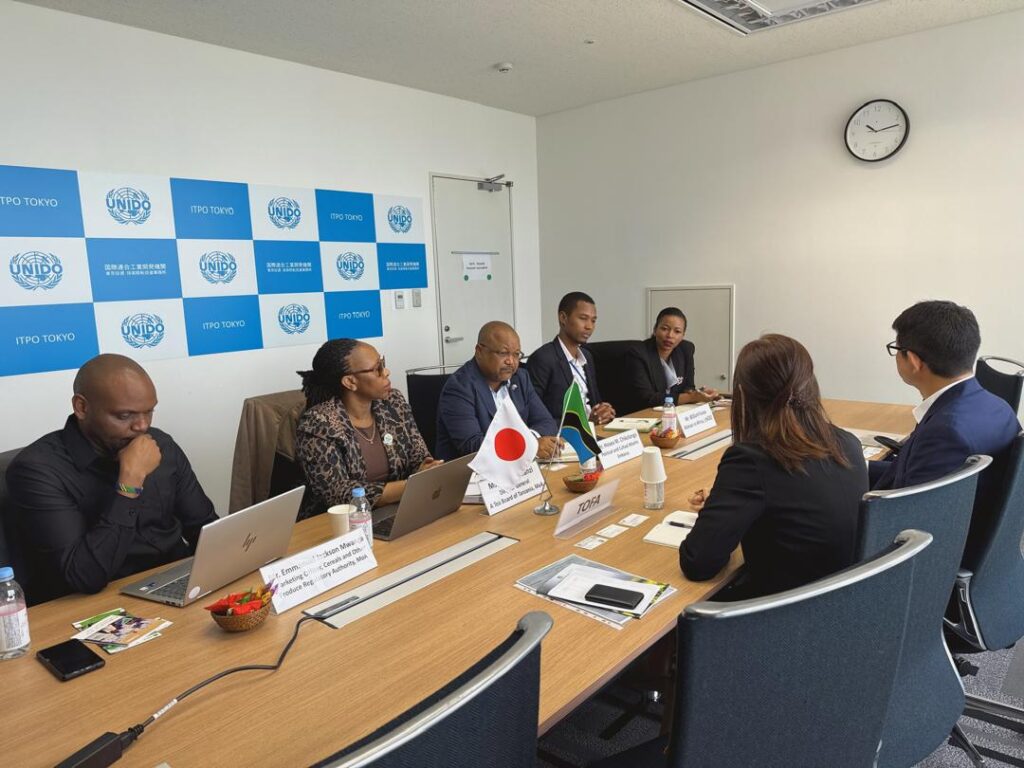
The Director of the Tanzania Tea Board, Ms. Beatrice Banzi (second from left), attending an international conference in Japan to promote Tanzanian tea and attract investors.
“Our tea industry is strategically positioned to become a global leader in quality, sustainability, and value addition – backed by a growing middle-income economy and robust government support” says Abdulmajid Nsekela, Chairman, TBT Board of Directors.