

By Business Insider Reporter
As Tanzania embarks on its long-term development journey toward Dira2050, the legal and judicial sectors are quietly undergoing one of the most transformative overhauls in decades – anchoring not only governance but also economic and social stability.
From digitization and access to justice, to institutional growth, financial efficiency, and regional leadership, recent milestones reveal a legal system evolving from manual, fragmented structures into a cohesive, tech-enabled engine of public service and national integration.
A historic legal reform, in Kiswahili
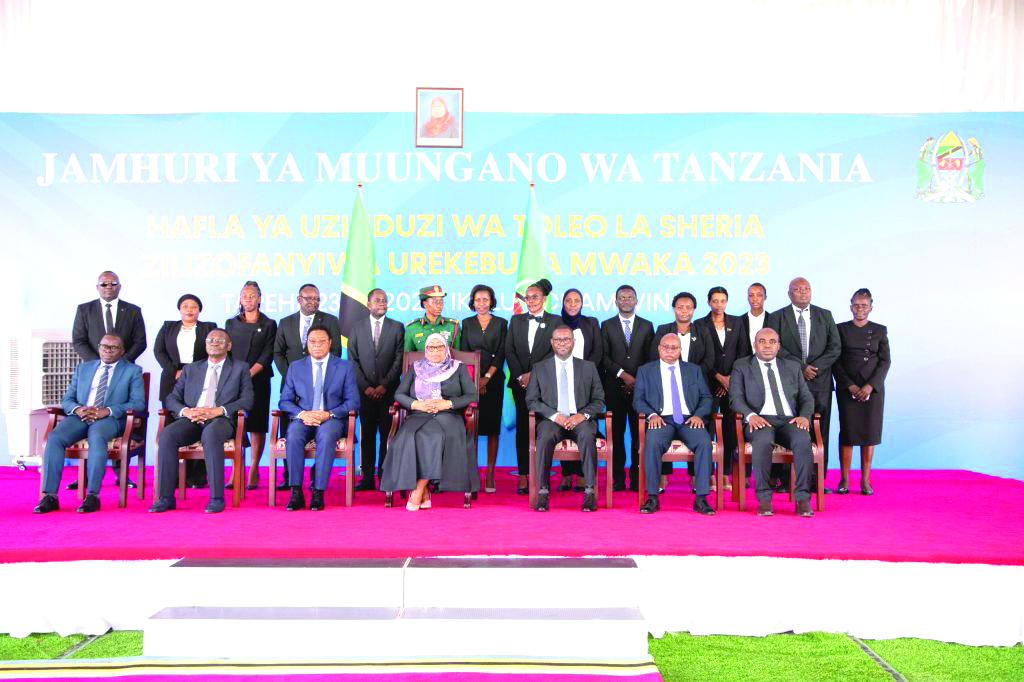
In what legal scholars are calling a landmark national achievement, the government finalized the 2023 Revised Edition of the Laws of Tanzania, which consolidates and translates all 446 principal laws into Kiswahili – the country’s official language.
The updated edition, which takes effect on July 1, 2025, is the first of its kind to be fully funded domestically without reliance on World Bank or foreign support.
This bold move democratizes the law, making legal knowledge accessible to the general population and ensuring that Tanzanians can interact with legal texts in a language they understand.
“Legal ownership begins with language,” said Attorney General Hamza Johari, who spearheaded the reform. “This will help close the justice gap between the law and the people.”
From 2021 to 2025, Tanzania has also enacted or amended 57 principal laws and over 4,000 subsidiary instruments, modernizing the legal framework across sectors like finance, environment, land, and digital economy.
Access to justice in the digital era
The Mama Samia Legal Aid Campaign, launched under President Samia Suluhu Hassan, is another pillar of transformation.
Legal aid desks established across 25 regions have directly assisted 2.7 million people, while more than 6.4 million Tanzanians have received legal education through outreach and public platforms.
Simultaneously, Tanzania’s partnership with Laws.Africa and GIZ led to the digitisation of nearly 40% of national legislation by the end of 2023 using the Indigo platform. These laws, along with thousands of court decisions, are now freely accessible via the Tanzania Legal Information Institute (TanzLII), which by June 2025 had hosted 65,815 court rulings and attracted 2.6 million users.
TanzLII’s success has drawn interest from across Africa – delegations from Ghana and Nigeria visited in June 2025 to study the model as part of South-South legal cooperation.
Building legal infrastructure

Launch of the Permanent Legal Advisory Committee at the Regional and District Levels and the Free Legal Aid Clinic for the citizens
Legal reform is being backed by concrete investment in infrastructure and personnel:
Judges have increased from 92 in 2021 to 146 in 2025
Magistrates grew from 1,412 to 1,426
Six Integrated Justice Centres (IJCs) have been completed in cities like Dodoma and Mwanza, with nine more under construction
Dozens of district and primary courts have also been built or upgraded, especially in underserved rural areas
These efforts reduce case backlogs, increase judicial access, and position Tanzania as a leader in justice infrastructure development in the region.
Litigation success saves money
Beyond the courtroom, Tanzania’s legal institutions have also delivered substantial financial gains. In 2024–2025 alone, the Solicitor General’s Office successfully resolved 966 civil cases – 814 domestic and one international – saving the government an estimated TSh232.7 billion (over $100 million).
This outcome reflects improved risk mitigation, early legal intervention, and professionalization of state attorneys, whose capacity is being bolstered through the “Legal Excellence for Tomorrow” training program launched in June 2025.
The program also includes a new Case Management Information System (CMIS), an online legal library and a modernized State Attorneys’ web portal
Regional leadership
Tanzania’s advancements are earning it continental recognition. In addition to hosting West African delegations, the country is playing a pivotal role in shaping Africa’s approach to open legal information, access to justice, and digital judicial systems.
Attorney General Johari and Solicitor General Dr. Ally Possi, have also linked legal modernisation efforts to Vision 2050, calling on legal professionals to align legal structures with the country’s socio-economic aspirations, including industrialization, investment attraction, and digital economy growth.
“The legal sector must be at the centre of national development – not on the periphery,” Johari emphasized during a regional conference in Arusha.
Why this matters
Tanzania’s transformation is not just about courts and codes – it’s about creating a legal system that protects rights, attracts investment, fosters trust, and supports inclusive development.

For businesses, this means clearer laws, faster dispute resolution, and more predictable regulatory frameworks. For citizens, it means more justice, closer to home. For the region, Tanzania is emerging as a model for legal reform in Africa – rooted in local languages, driven by technology, and focused on public impact.
As Vision 2050 gathers momentum, the legal sector may well be its silent engine – setting standards for transparency, equity, and efficiency in governance and economic management.