


By Business Insider Reporter
Entrepreneurs in Tanzania have been urged to step up innovation, improve product standards and expand their competitiveness in order to penetrate international markets, as the country grapples with persistent structural challenges facing small and medium-sized enterprises (SMEs).
The call was made by Dr. John Jingu, Permanent Secretary in the Ministry of Community Development, Gender, Women and Special Groups, during the closing ceremony marking 20 years of the Tanzania Women Chamber of Commerce (TWCC) at Mnazi Mmoja grounds in Dar es Salaam recently.
Dr. Jingu said the time had come for Tanzanian entrepreneurs – particularly women – to prioritise quality, certification and product innovation to meet both domestic and export market standards.
“It is no longer sufficient to produce for survival. Our entrepreneurs must produce for scale, for quality and for international competitiveness,” he said.
SMEs: Backbone but under pressure
Small and medium-sized enterprises form the backbone of Tanzania’s economy, accounting for the majority of non-farm employment and a significant share of household incomes. However, many operate informally, face limited access to finance, struggle with compliance costs and lack exposure to export-ready standards.
While the government has in recent years expanded credit schemes and business development programmes, SMEs continue to cite high borrowing costs, limited collateral, market access barriers and inadequate packaging and branding capacity as key constraints.
Women-owned businesses, in particular, often face additional hurdles, including limited capitalisation and restricted access to formal supply chains.
Against this backdrop, Dr. Jingu emphasised that innovation – from product design to value addition and digital marketing – would be essential if local enterprises are to transition from micro-scale survival businesses to growth-oriented ventures capable of competing regionally and globally.
Exhibitions as market platforms
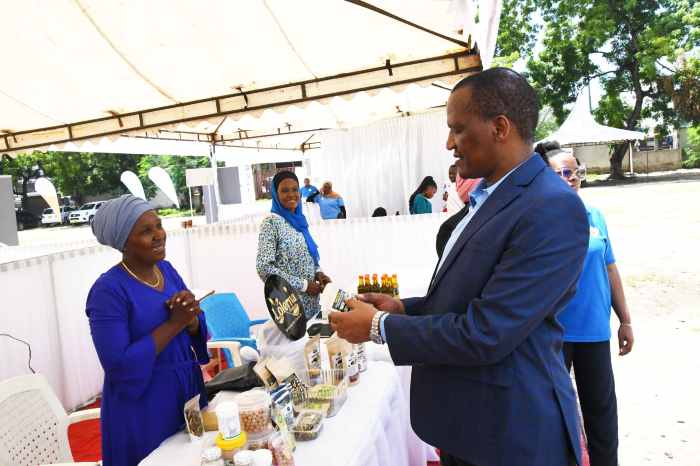
He described the anniversary exhibition as a strategic platform enabling entrepreneurs to promote and sell their products, learn modern business techniques and expand networks with buyers and development partners.
Such forums, he said, are critical in helping small businesses build visibility and credibility, particularly as Tanzania seeks to deepen its participation in regional and continental trade frameworks.
TWCC: Women’s economic empowerment
TWCC Executive Director Mwajuma Hamza said the 20-year milestone reflects the resilience and determination of Tanzanian women entrepreneurs who have worked to improve their economic standing and contribute to national development.
“Over the years, our institution has served as a bridge connecting women entrepreneurs to market opportunities, capital, training and business networks,” she said.
She added that the Chamber has also acted as an advocacy platform, engaging government and development partners to improve the business environment and ensure that policy reforms address the practical realities faced by women-led enterprises.
Entrepreneurs see tangible gains
For participating entrepreneurs such as Paula Joseph, the exhibition provided direct commercial benefits. She said showcasing her products had expanded her customer base and opened new business opportunities, while exposing her to competitive market dynamics.
She encouraged women and young girls to participate actively in such forums, describing them as invaluable opportunities to sell products, gain knowledge and broaden market reach.
The road to global markets
As Tanzania positions itself for industrial expansion and greater export participation, the competitiveness of its small businesses will be decisive.
Without improvements in productivity, standards compliance and value addition, SMEs risk remaining confined to saturated local markets.
Dr. Jingu’s message signals a broader policy push: transforming Tanzania’s entrepreneurial base from fragmented, informal micro-ventures into innovative enterprises capable of integrating into regional and international value chains. For many small businesses facing tight margins and limited capital, the path to global markets may be challenging. Yet, as stakeholders at the TWCC anniversary noted, innovation, collaboration and sustained institutional support could enable Tanzania’s entrepreneurs – especially women – to move from subsistence to scale, and from local trade to global competitiveness.