By A Special Correspondent
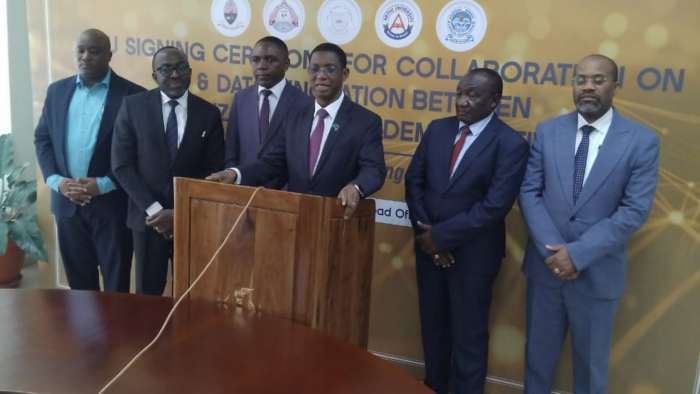
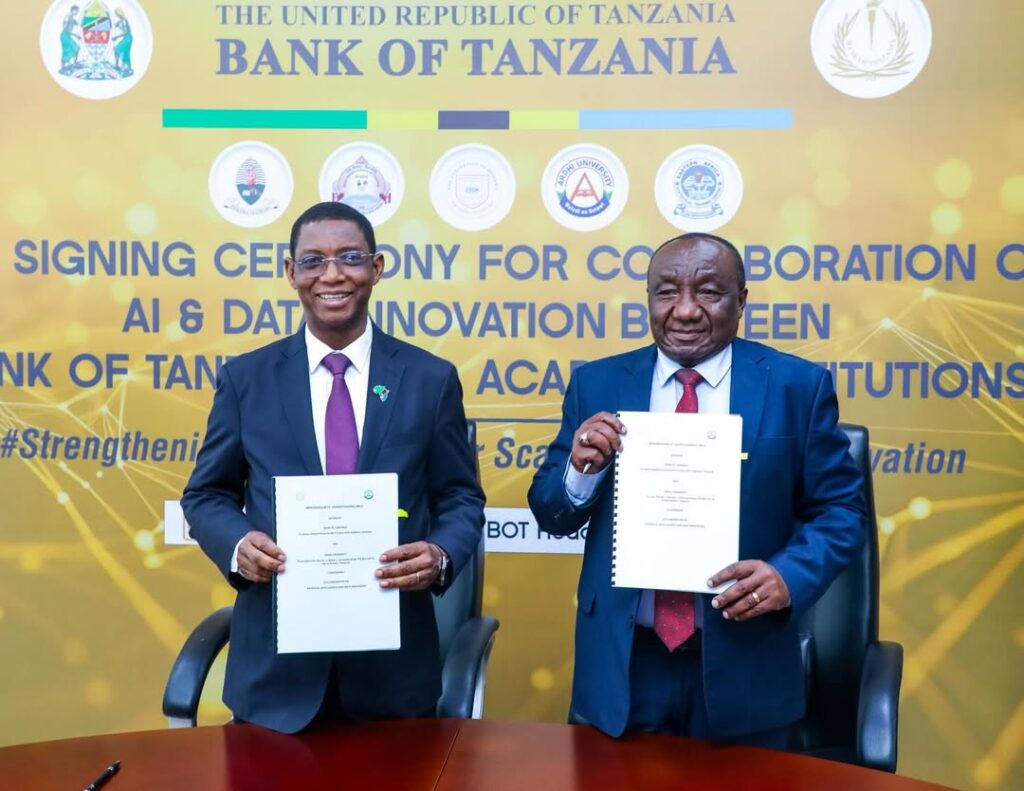
The Bank of Tanzania (BoT) has moved to place local universities at the centre of the country’s artificial intelligence (AI) and data innovation agenda, signing a series of strategic Memoranda of Understanding (MoUs) with five universities to accelerate technology-driven transformation in the financial sector.
The agreements, signed in Dodoma last week, signal a deliberate push by the central bank to cultivate home-grown expertise and reduce reliance on imported solutions by working directly with local academic institutions.
The University of Dar es Salaam (UDSM) stands out as a key partner in the initiative, reflecting its research capacity in AI, data science and advanced computing.
BoT Governor Emmanuel Tutuba described the MoUs as part of a broader strategy to future-proof Tanzania’s financial system against rapid technological change.
“These partnerships mark a strategic milestone in promoting responsible, locally driven innovation within the financial sector. By working closely with our universities, we are accelerating AI experimentation, testing analytical tools, and adapting global use cases to Tanzania’s realities in line with the Bank’s AI and data innovation strategy,” he said.
A core feature of the agreements is structured and secure data-sharing, designed to ease research constraints while maintaining compliance with data protection laws. This, BoT says, creates a trusted framework for experimentation and evidence-based policymaking.
Universities as innovation partners
For participating universities, the MoUs formalize a more direct role in shaping national financial sector development. At UDSM, the partnership aligns with its mandate to support national development through applied research and knowledge transfer.
Vice Chancellor Prof. William Anangisye said the collaboration shifts academic work closer to real-world problem-solving.
“This moves research beyond theory into application, enabling our scholars and students to directly strengthen financial systems, policy design and technological capacity,” he noted.
CoICT to drive implementation
At UDSM, implementation will be led by the College of Information and Communication Technologies (CoICT), particularly the Department of Computer Science and Engineering. The college will coordinate research teams working on BoT-defined problem statements.
Through BoT’s Planning Department, the central bank will issue Innovation Concept Notes highlighting priority financial sector challenges. These will be assigned to university researchers and student teams, with findings jointly evaluated by academic and BoT experts.
The partnerships also provide for anonymized or synthetic datasets, joint supervision, hackathons, AI bootcamps, symposia and co-authored publications. A Joint Technical Committee will monitor progress and track outputs such as policy briefs, research papers and deployable analytical tools.
Building a domestic AI pipeline
Beyond immediate research outputs, the initiative is designed to build a sustainable domestic pipeline of AI talent for Tanzania’s financial system. By embedding universities in live policy and regulatory challenges, BoT is effectively turning campuses into testing grounds for financial innovation. The MoUs collectively point to a strategic shift: positioning local universities not just as knowledge centres, but as active co-developers of Tanzania’s digital financial future and potential drivers of regional leadership in AI-enabled finance.