By Business Insider Reporter
Tanzania is emerging as one of the sub-Saharan African countries most affected by the latest wave of foreign aid reductions, as major donors scale back development assistance and reshape funding priorities.
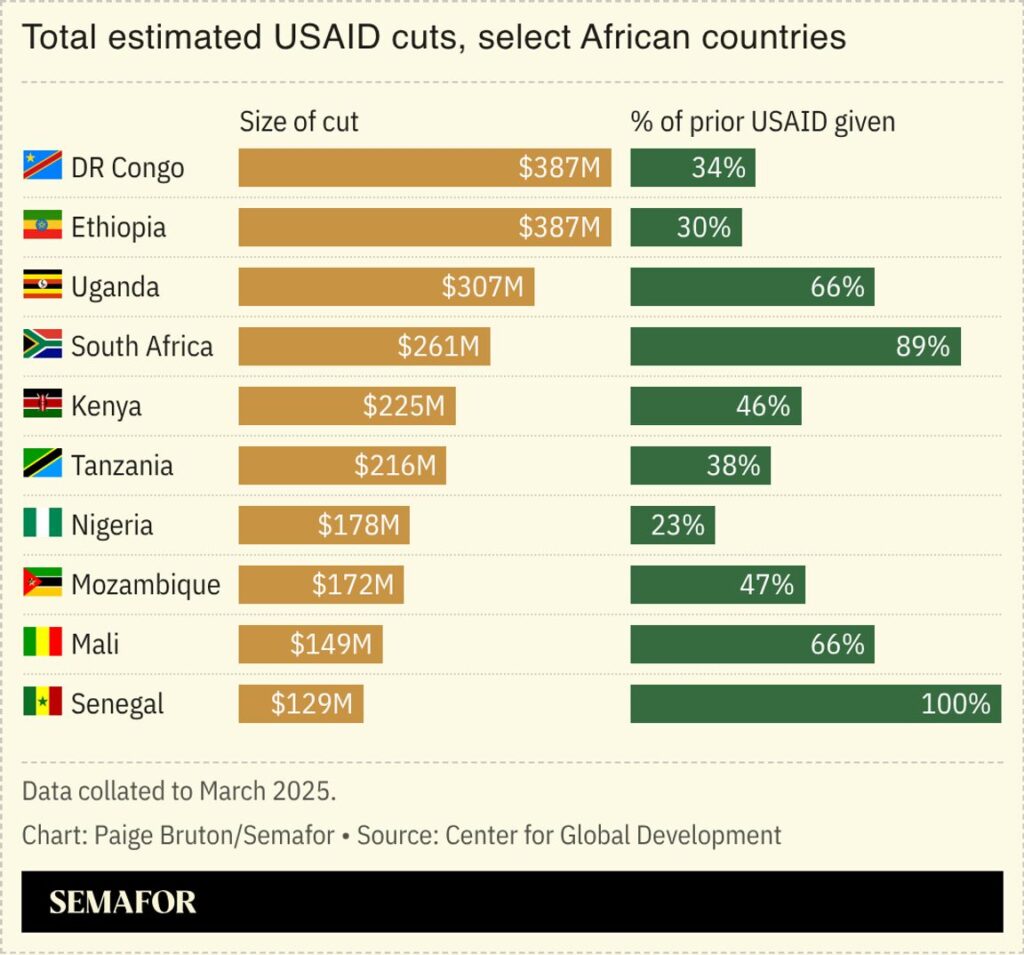
Recent estimates compiled by the Center for Global Development and visualised by Semafor Africa show Tanzania losing about US$216 million in USAID funding – roughly 38 percent of prior US assistance.
The scale of the reduction places Tanzania among the hardest-hit countries in the region, alongside nations such as the Democratic Republic of Congo and Ethiopia.
For Tanzania, where donor funding has historically supported key social and economic sectors, the consequences are already being felt.
Foreign aid has long financed programmes in public health, agriculture and community development, often delivered through partnerships with government institutions and non-governmental organisations.
Health programmes targeting HIV/AIDS, malaria and maternal care have been particularly reliant on donor support, making them vulnerable to sudden funding cuts.
The aid reductions come amid a broader contraction in global development financing. Analysts warn the trend could carry heavy human and economic costs, especially in lower-income countries with limited fiscal space.
A study cited in The Lancet Global Health estimates that declines in official development assistance (ODA) could contribute to 22.6 million additional deaths by 2030, with 38 African countries considered particularly at risk.
Researchers caution that even modest funding declines are associated with rising preventable mortality among adults and children.
Development stakeholders in Tanzania say abrupt funding gaps are disrupting service delivery, delaying procurement of medicines and medical supplies, and threatening programmes that serve vulnerable communities.
Some civil society organisations dependent on donor grants are scaling back operations or facing closure, raising concerns about reduced outreach in rural and underserved areas.
In response, the government has acknowledged the tightening aid environment and is pushing for stronger domestic resource mobilisation and budget reprioritisation.
Policy measures include improving tax collection, widening the revenue base and prioritising critical sectors such as health and education.
Tanzania is also turning increasingly to public-private partnerships and multilateral financing to sustain infrastructure and social investments once supported by bilateral donors.
However, economists note that replacing large-scale grant funding with domestic or borrowed resources presents fiscal challenges.
Regionally, the pullback in aid is fuelling debate about Africa’s long-term development financing model. While some analysts see the shift as a catalyst for self-reliance and reform, others warn that rapid aid withdrawals risk reversing progress in health, poverty reduction and human development. As donor priorities evolve, Tanzania’s experience highlights the growing pressure on African economies to balance immediate social needs with the push toward more self-financed development.